November always feels like a turning point—days get shorter, the air gets crisp, and we start craving warmth in every form: sweaters, candlelight, and jewelry that looks like it caught the last gold of autumn. If you’re searching “birthstone month of November,” you’ll quickly notice something unusual: November has two official stones. Which one is “real,” and how do you choose between citrine and topaz without overpaying or buying the wrong gem?

What is the birthstone month of November (and why are there two)?
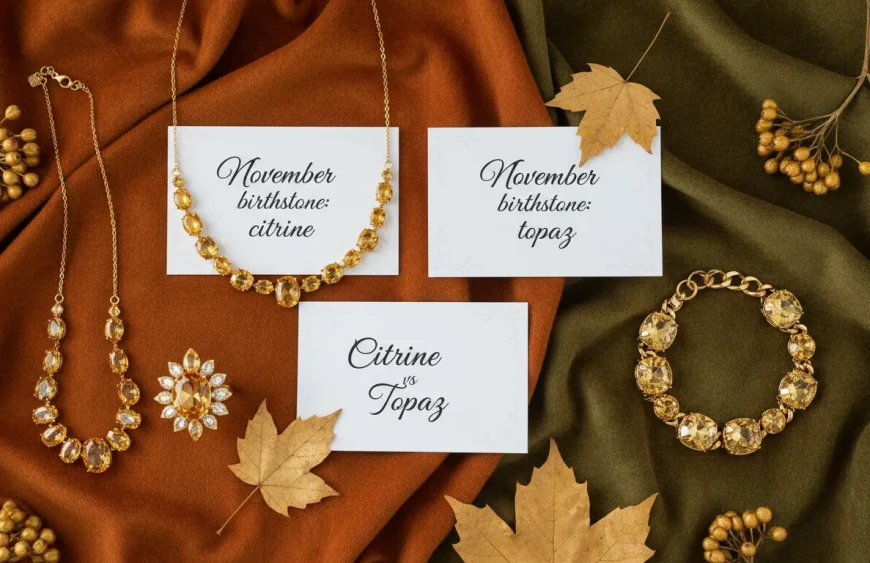
The birthstone month of November is represented by topaz and citrine—both recognized in modern birthstone lists. In practice, this “two-stone month” exists because birthstone lists evolved over time, and the jewelry industry expanded options so people could pick a stone that fits their style and budget. Historically, citrine and topaz were also confused with each other because they can share similar golden tones, especially to the untrained eye.
If you’re wondering, “What is the real birthstone for November?” the honest answer is: both are official today, with topaz holding deeper traditional roots and citrine widely embraced as a modern favorite.
Quick comparison: Citrine vs Topaz at a glance
When I help shoppers choose a birthstone month of November piece, I focus on four decision points: color, durability, price, and the “vibe” you want your jewelry to carry. Here’s a clear side-by-side.
| Feature | Citrine (Quartz) | Topaz (Mineral) | What it means for you |
|---|---|---|---|
| Official November birthstone? | Yes | Yes | November has two accepted choices |
| Typical color | Yellow to amber/orange | Many colors (yellow, blue, pink, clear; “Imperial” is prized) | Topaz gives more color freedom |
| Mohs hardness | 7 | 8 | Topaz resists scratches slightly better |
| Toughness / risk | Generally wearable; avoid high heat | Can cleave if hit at the wrong angle | Topaz needs more careful setting and wear |
| Price range | Usually more affordable | Can be affordable (blue) to costly (Imperial) | Citrine is budget-friendly; Imperial topaz is premium |
| Common look confusion | Often mistaken for “yellow topaz” | Often assumed to be citrine when golden | Ask for species and any treatment disclosure |
To go deeper on choosing authentic citrine, I’d also point you to StarryBead’s guide: Birthstone Citrine: Meaning, Benefits, and How to Choose Real Citrine Jewelry (November’s Golden Gem).

Citrine: the sunny side of the birthstone month of November
Citrine is the golden, honeyed quartz that looks like it’s lit from within. Gemologically, it’s a variety of quartz (hardness ~7), and it’s often chosen for daily-wear jewelry because it balances beauty with practicality. In my own wear tests—bracelet stacks, lots of desk time, occasional accidental taps—citrine tends to stay looking “clean and bright” with basic care.
Symbolically, citrine is often linked with:
- Joy and optimism
- Creativity and mental clarity
- Prosperity/abundance (it’s sometimes nicknamed the “merchant’s stone”)
If you want a more detailed authenticity checklist, StarryBead breaks it down in Citrine 101: Color, Origins, and How to Spot Fakes.
Topaz: the classic November birthstone (with more colors than you expect)
Topaz is its own mineral species and is famous for variety—especially blue topaz, but also golden hues and the highly prized Imperial topaz (often a pinkish-orange to reddish golden tone). On the Mohs scale it ranks around 8, so it can be a great choice for everyday jewelry.
The catch (and it’s important): topaz has perfect cleavage, meaning a sharp impact at the wrong angle can cause it to crack or split. So if you’re choosing topaz for the birthstone month of November, prioritize protective settings (bezels, halos, low profiles) and mindful wear.
For a focused deep dive on color types and value, see StarryBead’s: Topaz Stones: Colors, Meanings, Value & How to Choose the Right One for Jewelry.
Citrine vs Topaz: Comparing Two November Birthstones
What is the official color of November?
If you’re building a gift around the birthstone month of November, the signature color most people recognize is golden yellow—think late-autumn sunlight. Citrine naturally lives in that palette. Topaz can match it in golden varieties, but it can also go blue, pink, and clear, which makes it more flexible for personal style.
A simple styling formula I’ve seen work well:
- Mustard yellow + gold metal + citrine for warmth
- Charcoal or forest green + silver metal + blue topaz for contrast
- Deep plum + rose gold + Imperial-toned topaz for a luxe fall look
How to choose between citrine and topaz (a simple decision path)
When someone tells me, “I just want the best November stone,” I ask these quick questions:
-
Do you want classic or cheerful?
- Classic + historic feel: topaz
- Bright, sunny, easy-to-wear: citrine
-
Is this for daily wear (especially rings)?
- If you’re hard on jewelry: citrine is forgiving
- If you choose topaz: pick a protective setting and remove it for rough tasks
-
Do you care about rare/collectible value?
- Imperial topaz can be a collector gem
- Citrine is usually more affordable and accessible
-
Are you shopping by energy/meaning? (wellness jewelry angle)
- Citrine often aligns with confidence, joy, motivation
- Topaz often aligns with clarity, emotional balance, inner strength
Care tips for November birthstone jewelry (so it lasts)
Both stones from the birthstone month of November do best with gentle, consistent care.
- Cleaning: warm water + mild soap + soft brush/cloth
- Avoid: harsh chemicals, sudden heat, and rough knocks
- Storage: keep pieces separated to prevent scratches
Extra caution:
- For topaz, skip steam/ultrasonic cleaning and protect it from impacts because of cleavage risk.
- For citrine, avoid prolonged high heat or intense sunlight exposure that can dull color over time.
For gem care standards and properties, the most reliable baseline references are from gemological authorities like GIA’s November birthstones overview and GIA’s citrine care guide. For professional gem education and testing context, Gem-A’s notes are also helpful: Gem-A: Understanding and testing for rare natural citrine.

A short story from the bench: why “yellow topaz” can be a trap
The most common mix-up I see in November shopping is someone ordering “yellow topaz” online and receiving a stone that behaves (and prices) like quartz. I tried this myself years ago—bought what was advertised as golden topaz, then compared it next to known citrine under simple lighting. The color looked right, but the labeling and documentation didn’t: no clear species disclosure, no meaningful certificate, and very vague sourcing.
If you’re buying the birthstone month of November as a meaningful gift, request clarity on:
- the stone species (topaz vs quartz/citrine)
- any treatments (common in the market)
- authenticity proof (StarryBead, for example, emphasizes natural materials and certificates)
Conclusion: choosing the right birthstone month of November for your story
The birthstone month of November is special because it gives you two honest paths: citrine for bright, golden optimism and everyday ease, or topaz for classic heritage and a wider color world (with a bit more care required). Picture the person you’re gifting—or the version of you you’re stepping into this season—and let that decide the stone.
If you’ve worn citrine or topaz before, share what you noticed (color, durability, compliments) in the comments—your experience helps other shoppers choose with confidence.
FAQ: Birthstone Month of November
1) What is the real birthstone for November?
Both topaz and citrine are official modern birthstones for the birthstone month of November, with topaz being the more traditional listing.
2) Can November have two birthstones?
Yes. November’s two birthstones are topaz and citrine, partly because they share similar warm colors and because birthstone lists were updated over time.
3) What is the official color of November?
Most guides associate November with golden yellow, echoing citrine’s natural palette and golden varieties of topaz.
4) What is the modern birthstone for the month of November?
Modern lists commonly recognize both citrine and topaz for the birthstone month of November.
5) Did November birthstone change?
Birthstone lists have been revised historically; citrine became more widely recognized in modern lists, giving November two accepted stones.
6) Is citrine or topaz better for everyday jewelry?
Citrine (quartz, Mohs ~7) is generally easy to wear. Topaz (Mohs ~8) resists scratches well but can cleave if struck, so it benefits from protective settings and careful handling.
7) Why do citrine and topaz get confused?
They can share similar golden tones; older trade naming and casual labeling (“yellow topaz”) also contributed to mix-ups. Always confirm the gem species and treatment details.