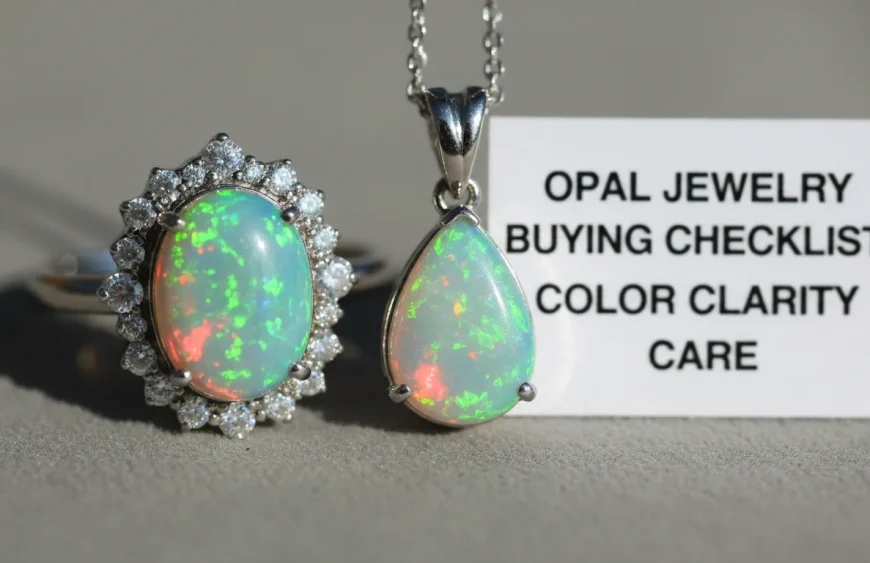
Opal jewelry has a way of “finding you” at the exact moment you need a little more light. I still remember the first opal ring I tried on: under store LEDs it looked calm, but the second I stepped into daylight, it flashed green and fire-red like it had its own mood. That’s the magic—and the trap—because opals can look wildly different depending on lighting, setting style, and even how you move your hand. This guide gives you a practical checklist for buying opal jewelry with confidence, plus simple care rules so your piece stays luminous for years.

Why opal jewelry is different (and why that’s the point)
Opal is prized for its play-of-color—those shifting rainbow flashes that appear as you tilt the stone. Unlike many gemstones where “bigger and clearer” is the whole story, opal jewelry is about pattern, color direction, body tone, and stability all working together. Two opals with the same size can feel like completely different gems in personality and value.
A quick reality check before you shop:
- Opal is softer than sapphire/diamond and can scratch if worn carelessly.
- It can be sensitive to heat and rapid temperature changes, which may cause cracking or “crazing.”
- Great opal jewelry isn’t always expensive—but high-end opal can be very valuable when rarity and beauty line up.
The opal jewelry buying checklist (use this in-store or online)
1) Color: judge the “fire,” not just the base
When people say an opal is “good,” they usually mean the color show is strong and lively. In opal jewelry, the most helpful way to evaluate color is to look for brightness first, then hue range, then how evenly it appears as you move.
What to look for
- Brightness: Do the colors pop in normal lighting (not just spotlights)?
- Color range: Does it show 2+ colors, or a full rainbow?
- Directionality: Does it “turn off” at certain angles, or stay active?
Quick test I use: view the stone in three lights—indirect daylight, indoor ambient light, and a shaded area. A great opal still looks alive in at least two of the three.

2) Pattern: the hidden “style” of the stone
Pattern is the geometry of the color patches—this is where opal becomes personal. Some patterns look like confetti; others look like stained glass.
Common patterns you’ll hear:
- Harlequin (rare): distinct, mosaic-like patches
- Pinfire: tiny sparkles across the surface
- Broad flash: large, sweeping color bands
- Rolling flash: color appears to roll as the stone moves
Buying tip: Choose pattern the way you choose fashion prints—pick what you’ll still love in a year, not just what’s loud today.
3) Body tone & type: know what you’re buying (and why it costs what it costs)
Not all opals are the same category. A light opal with subtle color can be beautiful (and often more budget-friendly), while black opal can command higher prices because the darker body tone can make colors look more intense.
Most common opal jewelry types
- White/light opal: pale body tone, often softer contrast
- Black opal: dark body tone, high contrast (often pricier)
- Boulder opal: opal in ironstone matrix; earthy, durable feel
- Fire opal: orange to red body color; may or may not show play-of-color
- Ethiopian opal: can be stunning; some are more prone to absorbing liquids (care matters)
If you want a deeper dive into glow and look-alikes, see our internal guide: Opalescent Stone: Meaning, Types, and How to Choose One That Actually Glows.
4) Clarity & surface: accept “natural,” avoid “damaged”
Opals can have inclusions, but your bigger concern is surface condition and structural integrity.
Check these before you buy
- Crazing: tiny crackle lines—avoid
- Chips on edges: especially on rings—avoid or negotiate price
- Scratches: visible under light—common in pre-owned pieces
- Polish quality: a good polish looks crisp and glassy, not hazy
Can a jeweler tell if an opal is real? Yes—gemologists typically use magnification to assess natural patterning and inclusions. If you’re buying online, ask for macro videos in natural daylight, not only studio photos.
5) Setting & wearability: match opal jewelry to your lifestyle
This is where many regrets happen. Opals are perfect for everyday joy—but not every opal style is an everyday wear piece.
Best settings for protection
- Bezel settings (metal rim around stone)
- Halo designs that guard edges
- Lower-profile rings (less snagging)
If you’re hard on your hands, consider:
- Opal pendants/necklaces (less impact than rings)
- Earrings for occasional wear
- Or rotate opal jewelry as a “gentle day” piece
For a broader mindset on caring for natural stones (without turning it into a chore), this internal guide pairs well: Crystals, Explained: How to Choose, Wear, and Care for Natural Stones (Without the Hype).
Opal jewelry quick comparison table (buying + care at a glance)
| Opal type | Look you’ll notice | Typical strengths | Common watch-outs | Best jewelry styles |
|---|---|---|---|---|
| White/Light opal | Soft, milky base with color flashes | Often affordable, classic | Can look “quiet” in low light | Pendants, studs, gentle-wear rings |
| Black opal | Dark base with high-contrast color | High visual impact, rare | Higher price, still needs care | Statement rings, pendants |
| Boulder opal | Color seams with ironstone matrix | Earthy style, often robust look | Pattern may be irregular (that’s the charm) | Pendants, men’s rings, cuffs |
| Fire opal | Orange/red body color | Bold warmth, unique | Some have little play-of-color | Pendants, earrings |
| Ethiopian opal (some varieties) | Bright, often neon-like flashes | Stunning value for looks | Some can absorb liquids/oils; avoid exposure | Earrings, pendants; rings with extra caution |
Care checklist: keep opal jewelry glowing (without overthinking it)
Opal jewelry care is mostly about avoiding extremes. Opal can be affected by heat, harsh chemicals, and sudden temperature changes. For cleaning, keep it gentle—think “spa day,” not “industrial scrub.”
Do
- Wipe with a soft, damp cloth after wear
- Use mild soap and lukewarm water if needed
- Store opal jewelry separately to prevent scratches
Don’t
- Use ultrasonic cleaners or steam cleaners
- Expose to harsh chemicals (including some household cleaners)
- Leave in hot sun, on a heater, or in a hot car
For general gemstone care guidance consistent with industry best practices, compare notes with the Gemological Institute of America (GIA) gemstone care articles and the American Gem Society consumer education.

Value & “is opal jewelry worth anything?”
Opal jewelry can absolutely be valuable, but the value isn’t one single lever. In my experience selling and comparing gemstone pieces side-by-side, opal value usually tracks with:
- Brightness + pattern rarity
- Type (e.g., black opal vs light opal)
- Size and cut quality
- Condition (no crazing, good polish)
- Provenance and documentation
If you’re trying to stay on budget, you can still get a meaningful piece under $100—especially in smaller pendants or minimalist designs. If you want investment-leaning opal jewelry, focus on stable condition, standout brightness, and a protective setting.
For broader gemstone pricing logic, the International Gem Society (IGS) opal overview is a helpful reference point.
Opal + wellness meaning (with a grounded approach)
Many people choose opal jewelry for more than aesthetics—it’s often associated with emotional soothing, creativity, and gentle self-expression. In StarryBead’s world, we treat that meaning as a personal ritual: the stone becomes a reminder to breathe, soften, and return to yourself when the day gets loud.
If you’re shopping opal for an October gift, this internal guide is a natural next step: Birthstone Month October: The Complete Guide to Opal & Tourmaline (Meaning, Colors, Care, and Gift Ideas).
Astrology notes (if you care about it—without the fear)
Search results often ask “Can Aries wear opal?” or “Can Libra wear opal?” In many modern styles of wearing gemstones, people simply choose what resonates. In some Vedic traditions, opal is linked with Venus energy and is often recommended for Libra, while some advise caution for Mars-dominant signs unless guided by an astrologer.
A practical middle path:
- If opal jewelry makes you feel calmer, more open, more like yourself—wear it.
- If you’re following a specific astrological system, consult a trusted practitioner and prioritize comfort and lifestyle fit.
Buying opal jewelry online: 7 questions to ask before you click “Add to cart”
- Can you share a video in natural daylight showing the play-of-color?
- Is this a solid opal, doublet, or triplet (and is it clearly disclosed)?
- Are there any signs of crazing, chips, or repairs?
- What’s the return policy if the color looks different in person?
- What is the setting metal and does it protect the edges?
- Is there any certificate or authenticity documentation?
- How should I clean and store this exact piece?
Opal: the Most Flamboyant Gem [Gem Buyer’s Guide]
Conclusion: choose the opal that matches your real life
Opal jewelry isn’t just a purchase—it’s a small relationship. The right piece will look beautiful in your daily lighting, fit your routines, and still surprise you when you catch it in a sunbeam. Use the checklist—color brightness, pattern, type, surface condition, and protective setting—and you’ll avoid the most common regrets while finding a gem that feels genuinely yours.
FAQ: Opal jewelry buying & care
1) Is opal jewelry worth anything?
Yes—value depends on brightness, pattern, type (like black opal), size, and condition. You can find affordable pieces under $100, while rare, high-brightness opals can reach thousands.
2) What can scratch an opal easily?
Harder gemstones (like sapphire, diamond, and even quartz) can scratch opal. Metal edges, grit, and rough surfaces can also leave marks—store opal jewelry separately.
3) Can a jeweler tell if an opal is real?
Yes. A jeweler or gemologist can inspect patterning, inclusions, and structure under magnification and may identify assembled stones (doublets/triplets) when disclosed or detectable.
4) How do I clean opal jewelry safely?
Use lukewarm water, mild soap, and a soft cloth. Avoid ultrasonic/steam cleaning and harsh chemicals.
5) Is it okay to wear opal jewelry every day?
It can be, but choose protective settings (like bezels) and avoid high-impact activities. Many people rotate opals as “gentle day” jewelry.
6) Can Aries wear opal? What about Libra?
Many wear what resonates; some Vedic traditions recommend opal for Libra and suggest Aries use caution unless advised. If it feels supportive and you wear it gently, it’s often fine.
7) Why does my opal look different in different lighting?
Play-of-color depends on angle and light source. Always evaluate opal jewelry in multiple lighting conditions before deciding.