Citrine is the friend who shows up like a pocket of sunlight—warm, steady, and easy to wear. If you’ve ever held a “golden” crystal and wondered, Is this real citrine… or just a pretty imposter? you’re in the right place. In my years sourcing stones for jewelry, citrine has been one of the most misunderstood crystals because true natural material is rarer than most shoppers expect. Let’s break down what citrine is, where it comes from, why color matters, and how to spot fakes with confidence.

What citrine is (and why it’s often confused)
Citrine is the yellow-to-orange variety of quartz (silicon dioxide, SiO₂). Its color is typically linked to trace iron and how that iron sits in the crystal structure—small chemistry shifts can push it from pale lemon to honey to brownish orange. Like all quartz, citrine ranks 7 on the Mohs hardness scale, which is why it’s popular in rings and daily-wear bracelets.
The confusion starts because the market has long used “citrine” as a color word, not a geology word. That’s how you end up seeing bright orange stones labeled as citrine even when they’re actually heat-treated amethyst or smoky quartz—still quartz, but not the same origin story. For gemstone basics and ID standards, I often reference the GIA citrine overview and cross-check properties against Citrine (quartz) on Wikipedia.
Citrine color: what “natural” usually looks like
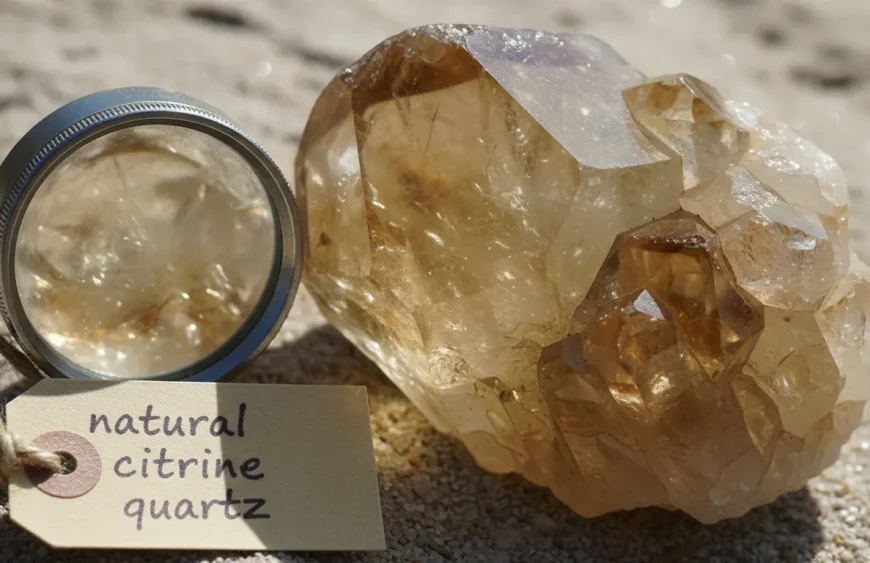
If you only remember one thing, remember this: natural citrine is often softer in color than the vivid pieces you see online. In hand, true natural citrine commonly shows:
- Pale yellow to light golden tones
- Honey or champagne shades
- Sometimes a faint smoky or greenish cast (still within quartz’s range)
In contrast, many mass-market “citrine” stones are a saturated orange with reddish or brown edges. That look can be real in nature, but it’s much more commonly produced through heating other quartz varieties. The International Gem Society’s citrine notes also discuss why mislabeling happens—especially confusion with topaz and treated quartz.

Origins: where citrine comes from (and what that implies)
Citrine forms in the same broad environments as other quartz: hydrothermal veins and cavities, often growing as crystals inside rock pockets. Brazil is a major source country for quartz in general, including citrine, but the important detail is how the color developed:
- Naturally colored citrine: iron-related coloration formed over geological time
- Heated quartz sold as citrine: color “finished” by human-applied heat (or accelerated compared to natural heating)
I’ve handled parcels where the paperwork said “citrine,” but the stones had that classic heated-amethyst look: strong orange color concentrated toward one end and a “burnt” brown base. Those pieces can still be beautiful for fashion—but if you’re paying a premium for natural citrine, you deserve clarity.
Natural citrine vs heat-treated amethyst: the most common “fake”
Calling heat-treated amethyst “fake” is a bit simplistic—because it’s still quartz, and treatment is common in gems. The problem is misrepresentation. Many sellers don’t disclose treatment, and shoppers assume they’re buying naturally colored citrine.
Here are the most common visual tells I use when reviewing inventory photos (and again when stones arrive):
-
Color zoning
- Natural citrine: generally more even, subtle zoning
- Heated amethyst: stronger zoning, often with abrupt color shifts
-
Hue
- Natural: lemon to honey, champagne, light amber
- Heated amethyst: deeper orange, orange-red, sometimes “rusty” tones
-
Crystal form
- Heated amethyst is frequently sold as geodes/druzy clusters (because amethyst commonly forms that way), then heated to turn orange.
- Natural citrine clusters exist, but the mass-market “burnt orange geode” is a classic red flag.
| Feature | Natural Citrine | Heat-Treated Amethyst Sold as Citrine | Glass/Resin Imitation |
|---|---|---|---|
| Typical color | Pale yellow to golden, sometimes smoky-yellow; generally subtle | Strong yellow-orange to reddish-brown (“burnt” orange), often intense | Very bright or uniform yellow/orange; can look “too perfect” or overly saturated |
| Color zoning | Usually fairly even; gentle gradients possible | Often obvious: white/clear base with orange at tips or patchy areas | Usually perfectly uniform (glass) or uneven swirls (resin dye) |
| Common forms (points/geodes/tumbled) | Faceted stones and tumbled pieces; natural points exist but are less common | Very common as sharp points, clusters, and geodes (heated amethyst from geodes) | Common as tumbled “stones,” beads, cabochons, carvings; “points” often molded |
| Price expectation | Mid-range; higher for clean, well-cut faceted material | Low to moderate; often sold cheaply in bulk | Very low; often sold as inexpensive beads or “gemstone” lots |
| Disclosure language to look for | “Natural citrine,” “untreated,” “no heat/no irradiation” (rarely stated but helpful) | “Heat-treated,” “heated amethyst,” “treated quartz,” “enhanced color” | “Glass,” “resin,” “simulated,” “imitation,” “man-made,” “composite,” “acrylic” |
| At-home checks (magnification, scratches, bubbles) | Magnification: natural inclusions/feathers possible; Scratch: should scratch glass (hardness ~7); Bubbles: none | Magnification: may show amethyst-like growth patterns; Scratch: also ~7 (scratches glass); Bubbles: none | Magnification: round bubbles common (glass) or flow lines/swirls (resin); Scratch: glass ~5.5 (may not scratch quartz), resin scratches easily; Bubbles: frequent in resin |
| Best use in jewelry | Everyday rings/bracelets/pendants; good durability, best in faceted settings | Fine for most jewelry (same durability as quartz); color may be less “citrine-like” in refined pieces | Best for low-impact fashion jewelry (earrings/pendants); avoid daily-wear rings, protect from scratches/heat/chemicals |
How to spot fake citrine at home (simple checks that work)
You don’t need a lab to avoid the obvious traps. Here’s a practical checklist I’ve used when inspecting citrine for jewelry-making:
-
Look for bubbles (glass indicator)
Under a loupe, round bubbles can suggest glass. Quartz can have inclusions, but spherical “air bubble” patterns are suspicious. -
Check the “too perfect” color
If every stone in a strand is identical neon orange, be cautious. Natural citrine typically shows gentle variation. -
Ask for disclosure language
Good listings say “natural citrine” or “heat-treated quartz/amethyst.” Vague labels like “yellow crystal” or “golden citrine” with no origin/treatment info are a risk. -
Consider price realism
Natural citrine is not the rarest gem on earth, but fine natural color costs more than treated material. If a large, saturated orange stone is very cheap, it’s likely treated quartz or glass. -
Request documentation (especially for fine pieces)
At StarryBead, we provide certificates for authenticity—because citrine is exactly the type of stone that benefits from clear, written verification.
Citrine: Real or Fake? – Natural or Heat Treated Amethyst?
Citrine in jewelry: wearability, care, and what I’ve learned
Quartz hardness (7) makes citrine sturdy for everyday jewelry, but it’s not indestructible. I’ve seen chipped girdles on rings from dropping them on tile, and I’ve seen surface dulling from harsh cleaning. Keep it simple:
- Clean with mild soap, warm water, and a soft brush
- Avoid high heat exposure and harsh chemicals
- Store separately to reduce scratching from harder stones
If you’re buying citrine for “energy” reasons, think of it like choosing a scent: personal and contextual. Many crystal lovers associate citrine with confidence, motivation, and a brighter mindset. Whether you treat that as spiritual practice or mindful symbolism, wearing a stone you genuinely love tends to be the point.
Buying citrine with confidence (a quick shopper script)
When you’re about to click “buy,” use this short set of questions:
- Is it natural citrine or heat-treated quartz?
- Is treatment disclosed clearly in the description or certificate?
- Do photos show realistic color (not oversaturated editing)?
- Does the price match the claimed grade and size?
- Is there a return policy if it doesn’t match the listing?
Authoritative gem references like GIA help you sanity-check claims, and educational guides like the International Gem Society help explain common mix-ups.

Conclusion: let citrine be sunlight you can verify
In the end, citrine should feel like clarity: bright, honest, and easy to live with. I’ve learned that the happiest customers aren’t the ones who buy the most expensive stone—they’re the ones who understand what they’re buying, why it looks the way it does, and how to tell if it’s being represented truthfully. If you want that sunny glow in your daily stack, choose citrine for its real color story, not a marketing shortcut.
FAQ about citrine
1) Is citrine a real gemstone or just a trade name?
Citrine is a real gemstone variety of quartz (SiO₂). The confusion comes from the trade using “citrine” for yellow/orange quartz that may be treated.
2) Why is so much citrine actually heat-treated amethyst?
Because amethyst is abundant and can turn yellow-orange when heated. It’s a common, accepted treatment when disclosed—but often it isn’t.
3) What color is natural citrine supposed to be?
Typically pale yellow to honey/champagne, sometimes with subtle smoky or greenish undertones—not always vivid orange.
4) How can I tell citrine from topaz?
Topaz and citrine can look similar in color, but they’re different minerals with different optical properties. In practice, ask for proper identification and documentation for higher-value purchases.
5) Does citrine fade in sunlight?
Quartz is generally stable, but prolonged intense light/heat can affect some treated stones or cause gradual changes over time. Store thoughtfully and avoid extreme exposure.
6) Can I wear citrine every day?
Yes. With Mohs hardness 7, citrine is suitable for daily wear, especially in earrings and necklaces. Rings need more care due to impact risk.
7) What should a seller disclose when selling citrine?
They should state whether it’s natural-color citrine or heat-treated quartz/amethyst, and ideally provide a certificate or reputable sourcing information.