A macrame crystal necklace walks into your day quietly: a small stone against your chest, a few patient knots holding it close, and somehow your whole outfit (and mood) feels more “you.” If you’ve ever wondered why these necklaces keep showing up in wellness circles and street style photos, the answer is simple: macrame is functional, comfortable, and expressive—while crystals add personal meaning. So what is a macrame crystal necklace really, and why does it work so well for everyday wear?

What a macrame crystal necklace is (in plain terms)
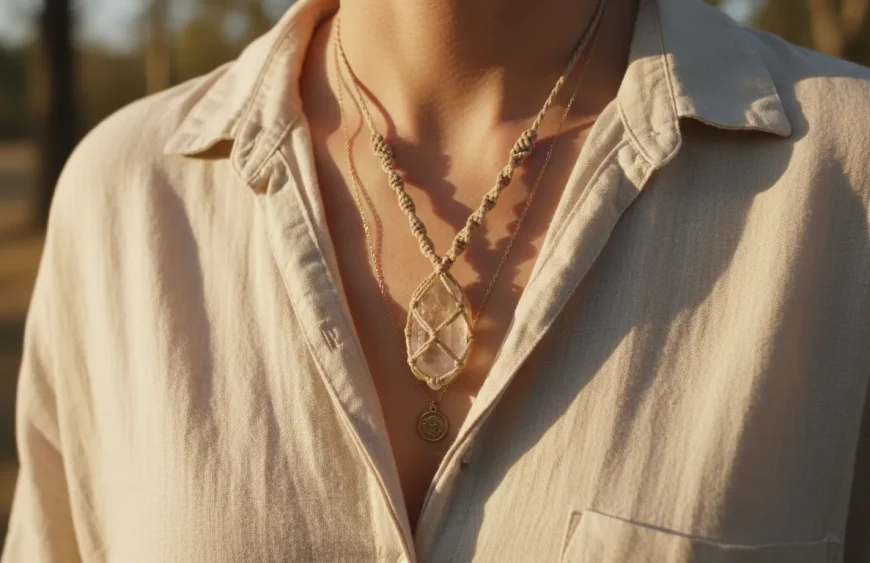
A macrame crystal necklace is a crystal or gemstone (often a point, tumble, or cabochon) secured in a hand-knotted cord setting instead of a metal prong or bezel. The knots form a “cage,” wrap, or net that grips the stone with tension and structure. Many designs use adjustable sliding knots, so the necklace can sit as a choker or a longer pendant.
What makes macrame unique is that the cord is the setting: it’s both the engineering and the decoration. When I first tried wearing one for a week straight, I noticed the comfort difference immediately—no cold metal edges, no flipping pendant bail, and it stayed centered better than most chain pendants.
Why a macrame crystal necklace works so well (style + function)
Macrame has stuck around because it solves practical problems while looking intentional. A well-made macrame crystal necklace typically “works” in four ways:
- It holds irregular stones securely. Many crystals aren’t cut into perfect jewelry shapes, and macrame adapts to points, raw chunks, and tumbled stones.
- It’s lighter and quieter than metal settings. Less clink, less pulling on hair, and often more comfortable on skin.
- It’s adjustable and layer-friendly. Sliding knots make it easy to pair with chains, chokers, or longer talismans.
- It signals craft and meaning. Hand-knotting reads as artisanal, and the crystal choice becomes a personal story.
For anyone building a “small but powerful” accessory wardrobe, this is why the macrame crystal necklace keeps earning a spot by the door.
The knotwork logic: how macrame settings actually grip a crystal
A macrame crystal necklace isn’t magic—it’s tension, friction, and smart geometry. The cord is usually waxed for grip and durability, and the pattern creates multiple contact points around the stone. The most common builds you’ll see:
- Crystal cage / net
A flexible net that cups the stone and tightens at the top. - Wrapped point holder
Designed for crystal points; holds the tip down and cinches above the shoulders of the stone. - Bezel-style macrame frame
A more structured, symmetrical border around a cabochon.
If you’ve ever seen “interchangeable” macrame designs, the idea is simple: the knot structure opens enough to swap stones, then tightens again—similar to what some DIY tutorials demonstrate (useful if you like changing crystals with your mood).
Choosing the right crystal for your macrame crystal necklace
Crystals are personal. StarryBead focuses on 100% natural crystals and gemstones with authenticity certificates, which matters if you care about provenance and consistency. From a wearability standpoint, here’s what tends to pair best with macrame:
- For everyday clarity and clean styling: Clear Quartz
- For grounded, protective vibes: Black Tourmaline or Smoky Quartz
- For calm, dreamy outfits: Amethyst or Aquamarine
- For confidence and warmth: Citrine or Red Persian Agate
- For earthy, textured looks: Green Jasper or Dalmatian Jasper
- For “electric” blue accent: Blue Kyanite (note: kyanite can be more delicate than quartz)
I’ve found that point-shaped stones look especially good in macrame because the cord can mirror the stone’s lines—almost like a frame that follows the energy of the silhouette.
Comfort and durability: what to look for before buying
Not all macrame is equal. A macrame crystal necklace should feel soft on skin but firm in structure. Before you add to cart, check these quality signals:
- Cord type: Waxed cotton or nylon cord tends to resist fuzzing and loosening.
- Knot consistency: Even spacing and symmetrical tension usually means the piece will age well.
- Edge comfort: No sharp cord ends; sealed tips; smooth transitions near the neck.
- Stone security: The crystal shouldn’t rattle or slide when you gently shake it.
- Adjustability: Sliding knots should move smoothly without slipping under normal wear.
If you plan to wear it daily, prioritize comfort and knot integrity over overly complex patterns that snag on hair or sweaters.
| Style | Best for | Pros (comfort/security/adjustability) | Watch-outs (stone slipping, cord stretch, snagging) | Recommended use (daily wear, layering, gifting, meditation) |
|---|---|---|---|---|
| Net cage | Tumbled stones | Comfortable; distributes weight; fits slight size variation | Stone can shift or rotate; cords can loosen over time; can snag on knits | Daily wear; gifting; casual layering |
| Wrapped point holder | Points | Very secure on pointed crystals; stable orientation; adjustable tension | Can mark softer stones; cord stretch may loosen grip; ends/knots can snag hair/clothes | Meditation; daily wear; gifting |
| Bezel-frame macrame | Cabochons | Smooth against skin; high security; polished, “jewelry-like” finish | Less adjustable to stone size; edges can catch if framing is bulky; slower to dry if wet | Daily wear; gifting; layering |
| Interchangeable holder | Swapping stones | Highly adjustable; easy to change stones; versatile styling | Higher risk of slipping if not tightened; hardware/knots can snag; frequent handling wears cord | Layering; gifting; travel; intention/meditation rotation |
Why it “works” in wellness culture (without overpromising)
A macrame crystal necklace sits at the intersection of ritual and routine. Many wearers use crystals as reminders—of calm, boundaries, confidence, or intention. That doesn’t mean a necklace replaces mental health care or medical treatment; it means the object can support your habits and mindset.
In my own routine, the biggest benefit was consistency: when I touched the pendant during a stressful moment, it became a cue to breathe and reset posture. That’s the real mechanism most people experience—tactile grounding, personal symbolism, and the daily practice of intention.
For evidence-based context on how rituals and symbolic objects can support behavior and meaning-making, it’s worth exploring research-led perspectives like the American Psychological Association and broader well-being frameworks from the National Institutes of Health. For crystal history and mineral reference (separate from wellness claims), the GIA gemstone encyclopedia is a reputable starting point.
Cost, value, and what you’re really paying for
Pricing for a macrame crystal necklace usually reflects three things:
- Stone quality and authenticity (natural vs. treated vs. synthetic)
- Craft time (knot complexity, symmetry, finishing)
- Brand service (certificates, support, shipping speed, returns)
StarryBead’s positioning—handcrafted design, natural materials, and authentication—fits buyers who want beauty plus peace of mind. If you’re the type who keeps one “signature necklace” on rotation, investing in workmanship is rarely wasted.

How to wear a macrame crystal necklace (so it looks intentional)
A macrame crystal necklace can lean boho, minimal, or even polished depending on styling. Try these combos:
- Clean and modern: one clear quartz point + white tee + blazer
- Soft and spiritual: amethyst + knit sweater + warm-toned makeup
- Protective everyday: black tourmaline + denim jacket + boots
- Layered texture: macrame pendant at mid-length + short pearl or fine chain above
The key is balance: macrame already has visual texture, so pair it with simpler fabrics or clean lines when you want the crystal to be the hero.
Easy Adjustable Sliding Square Knot Macrame Cord Bracelet Closure
Care tips (so your knots stay crisp)
Macrame cord can last a long time if you treat it like a favorite pair of shoes—wear often, clean gently, avoid soaking.
- Remove before swimming, showering, or heavy workouts.
- Store flat or hanging to prevent knot distortion.
- Spot-clean cord with mild soap and a damp cloth; dry fully.
- If the crystal is soft or brittle (some are), avoid knocks and drops.
If you buy from a shop that provides crystal authenticity certificates and responsive support (as StarryBead emphasizes), keep that documentation—especially if you gift the piece later.
Conclusion: the necklace that holds more than a crystal
A macrame crystal necklace works because it’s both practical and personal: knots that secure, a stone that symbolizes, and a design that feels like it was made for real life—not just a jewelry box. It’s the kind of accessory that quietly becomes part of your routine, the way a lucky scarf or a favorite ring does.
If you’re ready to choose one, start with the feeling you want to carry—calm, clarity, confidence, grounding—and match the stone and style to your daily life. Then tell your story with it.
FAQ about macrame crystal necklaces
1) What is a macrame crystal necklace made of?
Usually a natural crystal or gemstone held in place by hand-knotted cord (often waxed cotton or nylon), sometimes with an adjustable sliding knot.
2) Are macrame crystal necklaces durable for daily wear?
Yes—if the knots are tight and even and the cord is quality. Avoid water exposure and rough friction to extend lifespan.
3) Can I swap crystals in a macrame crystal necklace?
Some designs are interchangeable (cage/net styles). Others are tighter custom fits meant for one stone shape.
4) Do macrame crystal necklaces feel different than metal pendants?
They often feel lighter, warmer on skin, and less “clinky,” with fewer hard edges—great for all-day wear.
5) Which crystal is best for a first macrame crystal necklace?
Clear Quartz is versatile and easy to style. Black Tourmaline is popular for a grounded, protective everyday look.
6) How do I clean a macrame crystal necklace?
Wipe the cord with a damp cloth and mild soap if needed; dry fully. Avoid soaking, and be gentle with softer stones.
7) How do I know if a crystal in my necklace is real?
Buy from sellers who provide authenticity documentation and clear sourcing information—like a certificate for natural crystals and gemstones.